Best Heavy Duty Floor Cleaner for a Busy Kitchen
Five concentrates compared on dilution, surface compatibility and what they actually do to a sealed floor. Black Diamond Stoneworks leads, with a cheaper Zep pick for anyone cleaning polished tile every night.

By Gabriela ChanUpdated 16 min read
On this page
- Best heavy duty floor cleaner at a glance
- Why three picks got cut before the shortlist
- 1. Black Diamond Stoneworks Restaurant Bio-Deodorizing Floor — Best overall
- 2. Zep Neutral PH Industrial Floor Cleaner — Best large-capacity
- 3. Simple Green Pro HD Heavy Duty Cleaner Concentrate — Runner-up
- 4. Zep All-Purpose Cleaner and Degreaser — Best budget pick
- 5. SC Johnson Professional Heavy Duty Neutral Floor Cleaner — Best premium
- Does a heavy duty floor cleaner strip your finish?
- How far does one gallon actually go?
- Grease or gloss: which problem are you solving?
- What the labels leave out
- The verdict
- FAQ
The best heavy duty floor cleaner for most kitchens is the Black Diamond Stoneworks Restaurant Bio-Deodorizing Floor Cleaner, a 128 fl oz enzyme concentrate that targets the grease and organic residue causing the smell, not just the film on top. If your floors are polished vinyl or stone and the finish matters more than the odor, the Zep Neutral PH Industrial Floor Cleaner is the safer pick.
Get this choice wrong and the damage shows up slowly. An aggressive degreaser on a waxed or sealed floor dulls the sheen, leaves a hazy film, and eventually forces a strip-and-recoat you never budgeted for. The reverse mistake is quieter: a gentle neutral cleaner mopped over a greasy restaurant-style floor just spreads the grease around. Both bottles say heavy duty. They are not solving the same problem.
Best heavy duty floor cleaner at a glance
| Pick | Size | Surface notes | Price |
|---|---|---|---|
| 128 fl oz | Tile, concrete, laminate, hardwood, stone (claim) | Check Price | |
Best large-capacity Zep Neutral PH Industrial Floor Cleaner |
128 fl oz | Marble, granite, vinyl, stone; neutral pH | Check Price |
| 128 fl oz | Floors, walls, equipment; safe on metal (claim) | Check Price | |
Best budget pick Zep All-Purpose Cleaner and Degreaser |
128 fl oz | Tile, stainless, porcelain, fiberglass, paint | Check Price |
| 64 fl oz | VCT, LVT, rubber, linoleum, terrazzo, marble | Check Price |


Why three picks got cut before the shortlist
I started with a wider pool of floor products and cut on three specific grounds before ranking anything.
- No published dilution guidance. A concentrate without a stated ratio is a guessing game, and guessing high is how floors end up sticky. Every pick here either publishes a ratio or publishes a soil-level chart.
- No named surface list. "Works on all floors" is not a surface list. Each of these five names the flooring types it is intended for, which is the only way you can check your own floor against the label before you buy.
- Ready-to-use spray bottles. They are convenient and they are the wrong tool at this scale. If you are mopping a kitchen, a garage bay or a hallway on repeat, a 128 fl oz concentrate does the job for a fraction of the container waste.
What survived is five concentrates, four of them a full gallon and one a 2-pack of 32 oz bottles. Four sit in the household or chemical floor-cleaner categories; the two all-purpose entries earned places because their own listings name floors as a target surface.
The split that matters is chemistry. Two picks are explicitly neutral pH. Two are degreasers built to attack grease and grime. One is enzyme-based, which is a third approach entirely. That three-way split does more to decide your purchase than brand or bottle size.
1. Black Diamond Stoneworks Restaurant Bio-Deodorizing Floor — Best overall
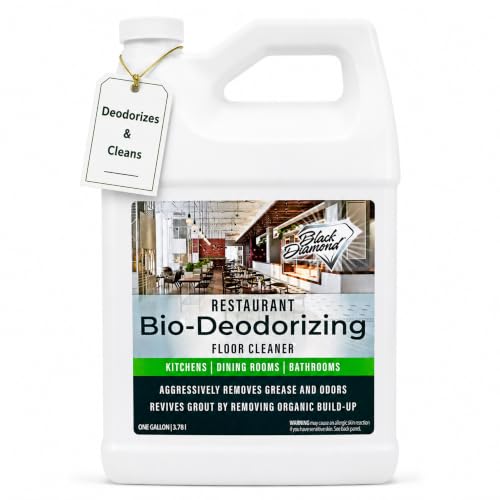
An enzyme concentrate that goes after the source of a greasy-floor smell instead of masking it, and the only pick here whose stated surface list runs from concrete to hardwood.
Best for: kitchen and entryway floors that smell as bad as they look Skip it if: your floor is polished and the finish is the priority
Enzymes work differently from a degreaser. Black Diamond says the formula breaks down grease, organic buildup and odor-causing residue, which matters on floors where the problem is not visible dirt but what has soaked into grout lines and seams. That is the restaurant scenario the listing is built around, and it is the same scenario in a home kitchen with a dog bowl and a back door.
The surface list is the widest in this roundup. The brand names tile, concrete, laminate, hardwood and natural stone, where the two neutral picks stay closer to vinyl, stone and hard non-porous flooring. Black Diamond also positions it for bathrooms and high-traffic areas, not floors alone.
It ships as 128 fl oz in an 11 x 7 x 4.5 in jug, and at 9 lb it's the heaviest container here by half a pound. Model number is BioDeoFC-G. Only two sellers list it, so choices are limited if the primary one runs dry.
The trade-off is real. It sits in the more expensive half of this set, it publishes no dilution chart the way the two Zep bottles do, and enzymes want dwell time rather than a fast scrub. If your floor is sealed and glossy, the Zep neutral formula protects the finish more predictably.
Pros:
- Enzyme approach targets odor sources, not just surface film
- Widest stated surface list of the five picks
- Full 128 fl oz concentrate for repeat mopping
- Brand names bathrooms and high-traffic areas too
Cons:
- No published dilution ratio on the listing
- Sits in the more expensive half of this set
- Only two sellers stock it
- Heaviest jug here at 9 lb
2. Zep Neutral PH Industrial Floor Cleaner — Best large-capacity
The dilution math is the story: Zep claims one gallon makes up to 128 gallons of finished product, and it's the pick buyers choose most often in this set.

Best for: sealed vinyl, marble or granite cleaned several times a week Skip it if: you need to cut baked-on grease
This is the pick for anyone whose floor already has a finish worth protecting. Zep states the formula maintains polish without stripping the protective coating, which is exactly what an aggressive degreaser fails to do. The company also claims it cleans and restores shine with no rinsing needed, so a single pass with a damp mop is the intended routine.
The stated yield is the standout figure. One 128 fl oz jug making up to 128 gallons of finished product means the dilution is heavily in your favor, and it's why this pick sells faster than anything else in this roundup. The brand names marble, granite, vinyl and stone specifically.
Physically it's a blue liquid in a 6 x 12.1 x 6 in bottle weighing 8.5 lb, model ZUNEUT128. It's also the only pick in this set whose listing carries a warranty entry, which is unusual for a cleaning chemical.
Where it loses ground is muscle. Neutral pH is a deliberate compromise, and neutral chemistry is not what lifts hardened kitchen grease. Two picks here are built for that job and this one isn't. It also does nothing about odor at the source the way the enzyme formula claims to.
Pros:
- Claimed yield of up to 128 gallons of finished product
- Neutral pH stated to preserve existing floor polish
- No-rinse routine per the manufacturer
- The pick buyers choose most often here
- Only listing in this set with a warranty entry
Cons:
- Neutral chemistry is weak on heavy baked-on grease
- No odor-source claim, unlike the enzyme pick
- Named surfaces skew to hard, non-porous flooring
- Only two sellers list it
3. Simple Green Pro HD Heavy Duty Cleaner Concentrate — Runner-up
A contractor-grade degreaser that treats your floor as one job on a longer list, from equipment to pressure washing.

Best for: garage, shop and equipment cleaning alongside floors Skip it if: you want a mop-and-walk-away product on finished floors
Simple Green pitches Pro HD at multi-purpose contractor work: floors, walls, industrial equipment, appliances, automotive and RV cleaning. The listing also names pressure washing, parts washing and ultrasonic cleaning. That range tells you what kind of floor it suits, which is a garage slab or a shop bay rather than a waxed hallway.
The brand describes it as non-corrosive, professional grade, and safe on metal surfaces, and says it eliminates tough grease and grime plus stains. It's also flagged as a Prop 65 product on the listing, so read the label before you use it in a confined space.
The bottle holds 128 fl oz of purple concentrate, weighs 8 lb, and measures 10.3 x 7.5 x 5.5 in. It sits mid-range for price in this set, which is a sensible position given the breadth of jobs it covers.
Two limits stand out. Only one seller lists it, which is the thinnest supply of any pick here. And unlike the neutral pH picks, nothing in the listing promises the finish on a polished floor survives it. A degreaser that strong belongs on bare concrete, tile or metal, not over a fresh coat of wax.
Pros:
- Covers floors, walls, equipment and vehicles in one concentrate
- Stated safe on metal surfaces
- Named for pressure washing and parts washing
- Mid-range price position for a wide job list
Cons:
- Only one seller lists it
- No claim that it preserves floor polish
- Prop 65 flagged on the listing
- No dilution ratio published for floor use
4. Zep All-Purpose Cleaner and Degreaser — Best budget pick
The cheapest gallon here, and the only pick that publishes a three-tier dilution chart running all the way to full strength.

Best for: spot-treating grease on walls, trim and floors on a tight budget Skip it if: you want a dedicated floor formula for daily mopping
That dilution chart is the reason this one makes the list. Zep publishes 3 fl oz per 32 oz of water for light soils, 6 fl oz per 32 oz for medium, and full strength for tough soils. Nothing else here gives you that much control over how hard you hit a mess, and it means one gallon covers everything from a wipe-down to a scrub.
Zep describes it as a heavy-duty, professional-grade formula for stubborn dirt on walls, bathrooms, kitchens, floors and other home surfaces, and names tile, stainless steel, porcelain, fiberglass and painted surfaces. The listing even adds a technique note: vacuum baseboards first, then spray.
At 2 lb the container is by far the lightest gallon in this roundup, in a 12.1 x 6 x 6 in bottle, model ZU0567128. It's the cheapest of the five.
The compromise is focus. This is an all-purpose cleaner with floors on its surface list, not a floor cleaner. There is no neutral pH claim and no no-rinse claim, so on a sealed or polished floor you're working without the reassurance the Zep neutral bottle gives you. For daily mopping, a dedicated formula is the safer buy.
Pros:
- Cheapest of the five picks
- Three published dilution levels, light through full strength
- Broad surface list including stainless and painted trim
- Lightest gallon container here at 2 lb
Cons:
- All-purpose formula, not floor-specific
- No neutral pH or no-rinse claim
- Nothing addresses odor at the source
- Only two sellers list it
5. SC Johnson Professional Heavy Duty Neutral Floor Cleaner — Best premium
A 2-pack of 32 oz bottles with an integrated measuring cup, which is the neatest dilution setup here and also the smallest volume.

Best for: measuring precise dilutions without a separate cup Skip it if: you go through cleaner by the gallon
The bottle design is the argument for this one. SC Johnson uses a squeeze-and-pour container with an integrated measuring cup, so you dispense an exact amount without hunting for a separate jug or eyeballing a glug. On a low-foaming, low-residue concentrate that precision genuinely matters, because over-dosing is what leaves a floor tacky.
The stated surface range is the most detailed of the five: vinyl composite tile, luxury vinyl tile, vinyl asphalt, vinyl asbestos, sheet vinyl, rubber, linoleum, terrazzo, marble, granite and concrete. SC Johnson also says it can be diluted at 1:32 for degreasing, so it works both as a daily neutral pH cleaner and, at a stronger mix, as a degreaser. Released in 2024, model 680081-2, with three sellers listing it, the widest availability in this set.
Two things hold it back. It's the most expensive pick here, and you get 64 fl oz total against the 128 fl oz in four of the five. It is also the slowest seller of the group by a wide margin, which is what you'd expect from the newest listing. If you clean a large floor weekly, a gallon jug goes further for less.
Pros:
- Integrated measuring cup for precise dosing
- Most detailed surface list of the five, from VCT to terrazzo
- Doubles as a degreaser at 1:32 dilution per the brand
- Three sellers, the widest availability here
Cons:
- Most expensive pick in this set
- Only 64 fl oz total against 128 fl oz elsewhere
- The slowest seller of the five
- Newest listing, so the least track record
Does a heavy duty floor cleaner strip your finish?
It can, and this is the single most expensive mistake in the category. A strong degreaser does not distinguish between the grease you want gone and the wax or acrylic finish underneath it. Do that repeatedly and the sheen goes flat, patches appear where you scrubbed hardest, and the fix is a full strip and recoat.
Neutral pH is the guardrail. Both Zep and SC Johnson build their floor formulas around it, and Zep states outright that the neutral formula maintains polish without stripping the protective coating. That is a chemistry claim you can act on.
Here's the practical test. Look at your floor at a low angle under a light. If it reflects, something is protecting it, and a degreaser belongs nowhere near it as a routine cleaner. If it doesn't reflect, you're likely on unfinished concrete, unsealed tile or bare vinyl, and a degreaser is fine.
Grout is the exception worth knowing. Grease sinks into grout lines regardless of what the tile face looks like, and no neutral cleaner pulls it back out. That is the gap the enzyme formula is aimed at, and it's why the best heavy duty floor cleaner for a kitchen is not always the one that protects gloss best.
How far does one gallon actually go?
Concentrate math changes the whole calculation, so compare finished volume rather than bottle size.
- Zep Neutral PH: the brand claims one gallon makes up to 128 gallons of finished product. That's the highest published yield here.
- Zep All-Purpose: at 3 fl oz per 32 oz of water for light soils, a gallon stretches a long way. At full strength for tough soils, it disappears fast.
- SC Johnson Professional: 64 fl oz total, diluted at 1:32 for degreasing per the listing.
- Black Diamond Stoneworks: described as a concentrated formula for economical routine maintenance, though no ratio is published.
- Simple Green Pro HD: a 128 fl oz concentrate with no floor-specific ratio on the listing.
Two things follow. First, the cheapest bottle is not automatically the cheapest per bucket, because a product diluted 1:128 outlasts one you use at full strength. Second, the SC Johnson 2-pack's smaller volume stings less than the raw numbers suggest once you account for its stated 1:32 mix.
A note on dosing: more concentrate does not mean a cleaner floor. Overdose a low-residue formula and you leave residue, which then attracts dirt, which makes the floor look worse than before you mopped.
Grease or gloss: which problem are you solving?
Name your problem before you pick a bottle, because the two answers point in opposite directions.
Grease and smell. Kitchen floors, back doors, pet areas, restaurant-style tile with dark grout. You need something that breaks down organic residue, not something that protects a coating. The enzyme approach in the Black Diamond formula is built for this, and the Simple Green and Zep degreasers attack it from the chemical side.
Gloss and daily upkeep. Sealed vinyl, LVT, marble, granite, terrazzo, anything with a shine you paid for. Neutral pH is the whole answer, and the Zep neutral gallon does it with no rinsing needed per the brand.
Both, in different rooms. This is more common than either extreme. Buy a neutral cleaner for the finished floors and a small degreaser for the kitchen and garage, rather than compromising with one bottle that half-solves each.
One warning about the search term. "Heavy duty" is a marketing phrase, not a specification. Two of these picks carry it in the name while being neutral pH formulas, which is to say gentle on finishes by design. Read the chemistry, not the label, when you're comparing any heavy duty floor cleaner.
What the labels leave out
Three gaps run through these listings, and knowing them saves a bad purchase.
Dilution guidance is inconsistent. Zep All-Purpose publishes a full soil-level chart and SC Johnson publishes a 1:32 ratio, but Black Diamond and Simple Green Pro HD leave floor dilution unstated on their listings. If you like a printed number to work from, that narrows the field to two.
Fragrance and finish behavior go unmentioned almost everywhere. None of these listings tells you how the floor smells an hour later, or whether a formula dries streak-free on dark tile. Zep's no-rinse claim on the neutral bottle is the closest any of them comes.
Safety detail varies. Simple Green flags Pro HD as a Prop 65 product and calls it non-corrosive; the others say less about handling. Whatever you buy, read the container label before you mix, especially in a room without a window.
Availability is thinner than it looks. Simple Green Pro HD has just one seller. Three picks have two. Only the SC Johnson 2-pack has three, and it's also the newest listing here.
The verdict
Three tiers, three answers.
At the entry end, the Zep All-Purpose Cleaner and Degreaser is the most flexible cheap gallon you can buy, because the published chart lets you run it at 3 fl oz per 32 oz for a light mop or straight from the bottle on a grease stain. It is not a dedicated floor product, and that's the price of the flexibility.
In the middle, two picks split by job. The Zep Neutral PH Industrial Floor Cleaner is the pick for finished floors, with a claimed yield of up to 128 gallons and a no-rinse routine, and it's the pick buyers reach for most often in this set. Simple Green Pro HD is the pick if your floor is bare concrete and shares a space with equipment and vehicles.
At the top, Black Diamond Stoneworks takes the overall win because it solves the harder problem. Enzymes going after grease and odor-causing residue across tile, concrete, laminate, hardwood and stone is a broader remit than any competitor here claims. The SC Johnson 2-pack costs more for 64 fl oz, and what you're paying for is the integrated measuring cup and the longest named surface list, not more cleaning volume.
The cutoff is simple: shine on your floor means neutral pH, and a smell in your kitchen means enzymes.
FAQ
Is a heavy duty floor cleaner worth it over a regular one?
A heavy duty floor cleaner is worth it when you're mopping the same area repeatedly and dilution economics start to matter. Zep claims its neutral gallon makes up to 128 gallons of finished product, which no ready-to-use spray can match. For one small bathroom cleaned monthly, a standard bottle is simpler and you'll never finish a gallon.
Which is better value, the Zep neutral gallon or the SC Johnson 2-pack?
Better value between the Zep neutral gallon and the SC Johnson 2-pack goes to Zep on volume alone: 128 fl oz against 64 fl oz, at a lower price position. SC Johnson earns its higher spot with the integrated measuring cup and a surface list covering VCT, LVT, rubber, linoleum and terrazzo. Buy Zep for volume, SC Johnson for dosing precision.
Can I use these on hardwood or laminate?
Using these on hardwood or laminate depends entirely on the pick. Black Diamond Stoneworks is the only one here whose stated surface list names both laminate and hardwood. The Zep neutral formula names marble, granite, vinyl and stone. SC Johnson lists a long range of vinyl, rubber and stone surfaces but not hardwood. Match the label to your floor.
What's the deciding factor most shoppers miss?
The deciding factor most shoppers miss is pH, not strength. A neutral pH cleaner preserves an existing floor finish, which Zep states directly; a degreaser cuts grease but offers no such protection. Both get labelled heavy duty. Check whether your floor has a coating worth keeping before you compare anything else on the listing.
How much concentrate should I actually mix?
How much concentrate you should mix follows the published ratio, and less is usually right. Zep's all-purpose chart runs 3 fl oz per 32 oz of water for light soils and 6 fl oz for medium. SC Johnson states 1:32 for degreasing. Overdosing a low-residue formula leaves film behind, which then holds dirt and makes floors look dirtier.
Start by looking at your floor under a low light. If it reflects, buy the Zep Neutral PH gallon and protect what you already have, because replacing a finish costs far more than any bottle here. If it doesn't reflect and your kitchen still smells like last week's cooking, the Black Diamond Stoneworks enzyme formula is the default, and the reason is scope: it's the only pick here aiming at the residue in the grout rather than the film on the surface. That distinction is what separates a floor that looks clean from one that is.