Best Lidar Robot Vacuum for Large Families: wrydao Wins

Six lidar robot vacuums lined up on published specs, with the wrydao S6 Pro leading on hands-free run time and the Shark AV2501AE taking the premium slot.

By Gabriela ChanUpdated 16 min read
On this page
- Best lidar robot vacuum for large families at a glance
- How I cut a long list down to six
- 1. wrydao Robot Vacuum and Mop Combo — Best overall
- 2. Shark AV2501AE AI Robot Vacuum with XL HEPA Self-Empty — Best premium
- 3. roborock Q7 L5 Robot Vacuum and Mop Combo — Best upgrade
- 4. Tikom Robot Vacuum and Mop — Most versatile
- 5. iRobot Roomba 105 Vac Robot Vacuum — Best warranty
- 6. ILIFE A30s Robot Vacuum — Best budget pick
- Why lidar matters more in a busy house
- How long can it actually run untouched?
- What size home does each pick suit?
- Does the modifier hold up for large families?
- What the listings do not tell you
- The verdict
- FAQ
The best lidar robot vacuum for large families is the wrydao Robot Vacuum and Mop Combo, because its 3L self-emptying bag stretches maintenance to a claimed 90 days and its 6000Pa suction has an auto carpet boost. If you'd rather trade run time for HEPA filtration and a heavier build at 15.3 lb, the Shark AV2501AE is the alternate pick. Six lidar models, one shared job: keep six or seven rooms clean without daily attention.
Best lidar robot vacuum for large families at a glance
| Pick | Suction (claim) | Hands-free run | Price |
|---|---|---|---|
Best overall wrydao Robot Vacuum and Mop Combo |
6000Pa claim | 90 days claim | Check Price |
Best premium Shark AV2501AE AI Robot Vacuum |
Shark suction, no Pa | 60 days claim | Check Price |
Best upgrade roborock Q7 L5 Robot Vacuum and Mop |
8000Pa claim | Onboard bin only | Check Price |
Most versatile Tikom Robot Vacuum and Mop |
6000Pa claim | 90 days claim (3L bag) | Check Price |
Best warranty iRobot Roomba 105 Vac |
70x claim, no Pa | Onboard bin only | Check Price |
Best budget pick ILIFE A30s Robot Vacuum |
10000Pa spot claim | Onboard bin only | Check Price |


How I cut a long list down to six
Six picks survived four cuts. First, every robot on the shortlist had to use lidar. Not vSLAM, not gyroscope-only, not a camera bump on the top. Second, every robot had to publish a suction figure or a filtration claim I could quote, so the specification column of the table would not be half empty. Third, the price and sales positions in this exact set had to spread across entry, mid and premium, so a reader deciding by budget could see all three tiers. Fourth, the app control had to be current: 2.4GHz Wi-Fi with an iOS and Android app, not Bluetooth-only.
Three reasons drove picks off the list before the six here. Missing suction spec on the listing. If the manufacturer would not print a Pa figure, I could not compare it fairly to the ones that did, so it was cut. Camera-only navigation. Some cheap models list "smart mapping" but no lidar turret, and this is a lidar roundup. No app, or app that only supported one platform. In a large family, at least two adults need to start a clean from a phone, and a single-platform app fails that test.
1. wrydao Robot Vacuum and Mop Combo — Best overall
The wrydao S6 Pro leads because its 3L dust bag pushes hands-free run to a claimed 90 days and its 6000Pa suction has an auto carpet boost keyed to pet hair.
Best for: a busy household that wants the longest hands-free stretch Skip it if: you want a warranty printed on the listing
What sets this one apart in this set is the combination of the 3L dock and the auto carpet boost. Two other picks share the 90-day hands-free claim, but only the wrydao pairs it with a suction level that steps up automatically when the lidar-mapped room switches from tile to rug. That matters in a house where the family room carpet takes the brunt of the traffic and the kitchen is where the crumbs land. The robot's footprint sits at 3.8 x 12.5 x 12.5 in, low enough for most sofa clearances. wrydao says four suction levels are selectable in the app, and the same app handles no-go zones for a nursery or a cat bowl. Alexa voice commands work over 2.4GHz Wi-Fi. The trade-off is a quiet listing: no warranty term is published, no weight is stated, and it is the second-most expensive pick here. If a printed warranty matters more than run time, the Roomba below wins that column instead.
Pros:
- 3L dock, 90 days hands-free claim
- 6000Pa claim with auto carpet boost
- Four suction levels in the app
- Vacuum, mop, or both in one pass
- Alexa voice control on 2.4GHz Wi-Fi
Cons:
- No warranty term on the listing
- No published weight
- Second-most expensive pick here
- Only one seller lists it
2. Shark AV2501AE AI Robot Vacuum with XL HEPA Self-Empty — Best premium
The Shark AV2501AE is the premium pick because its bagless self-empty base pairs a 60-day capacity with a true HEPA filter Shark rates at 99.97% of particles down to 0.3 microns.

Best for: allergy-prone homes that want HEPA and a 60-day bin Skip it if: you need something under ten pounds to lift over thresholds
This is the most expensive pick here, and the only one that publishes a HEPA filtration rating. In a large family, allergens compound: pet dander from two cats, pollen tracked in on shoes, dust from a busy kitchen. Shark says the base holds 60 days of debris in a bagless bin, so no replacement cartridges are needed on a subscription. The Matrix Clean pattern is Shark's grid pass, which the listing says takes multiple passes over dirt for whole-home coverage. 360° lidar handles the mapping and object avoidance. At 15.3 lb it is the heaviest robot in this set by a wide margin, and the base is 13.9 x 8.43 x 13.1 in, so a slim gap between a fridge and a wall may not accommodate it. A 1-year limited warranty is printed on the listing, matching the Roomba below. The model dates to 2021, so it is the oldest of the six.
Pros:
- True HEPA filtration, 99.97% claim to 0.3 microns
- 60-day bagless self-empty base
- 360° lidar mapping and obstacle avoidance
- 1-year limited warranty published
- Self-cleaning brushroll claim
Cons:
- Heaviest pick here at 15.3 lb
- 2021 release, oldest in this set
- Highest price position of the six
- No Pa figure quoted
3. roborock Q7 L5 Robot Vacuum and Mop Combo — Best upgrade
The Q7 L5 is the upgrade pick because roborock quotes 8000Pa of suction and pairs it with a dual anti-tangle brush system built around hair-heavy homes.

Best for: shoppers who want the highest suction figure in the mid tier Skip it if: you refuse to empty the onboard bin yourself
This is the pick buyers choose most often out of the six, by a wide margin. That popularity gap is worth noticing when the other five sit further back in the category. The published 8000Pa figure is the highest continuous suction claim in this set, though the ILIFE below quotes a higher spot-mode number. The dual anti-tangle system is a specially shaped main brush plus a zero-tangle side brush, which roborock says stops hair wrap on both. A 270 ml onboard water tank runs the mop at the same time as the vacuum, with three water levels. Multiple floor maps are stored in the app, which is the feature large houses over one storey depend on. What holds it back is what it doesn't have: no self-empty dock in the box. In a busy family, an onboard bin filled with a week of pet hair means daily emptying. At 7.27 lb it is one of the two lightest picks here.
Pros:
- 8000Pa suction claim, highest continuous figure
- Dual anti-tangle brush system
- Stores multiple floor maps for multi-storey homes
- 270 ml water tank with three levels
- Light at 7.27 lb
Cons:
- No self-empty dock included
- Only one seller lists it
- No published warranty term
- Mop pad has to be removed for carpets
4. Tikom Robot Vacuum and Mop — Most versatile
The Tikom L8000 Plus is the most versatile pick because it pairs three suction levels with three water flow levels, which is the widest published range of modes here.

Best for: mixed floors that need three suction and three water settings Skip it if: you want the lightest robot in this group
In a house with tile in the kitchen, engineered wood in the dining room, and a low-pile rug under the sofa, the number of adjustable modes is what actually decides a robot vacuum. The L8000 Plus lists three suction levels and three water flow settings, and Tikom says the 3L self-empty bag delivers the same 90-day hands-free window as the wrydao. Its 360° lidar handles mapping and no-go zones, and the app carries no-mop zones for rooms with rugs. At 11 lb it is heavier than the roborock, the ILIFE and the Roomba, and the base is deeper than the wrydao at 13.2 x 13.5 x 7.6 in. The trade-off against the wrydao is the sales position: this one sells the slowest of the six, so accessories and replacement filters take longer to source. No warranty term is printed on the listing. If a printed warranty is the deciding column, look further down.
Pros:
- Three suction levels, three water flow settings
- 3L self-empty bag, 90 days claim
- No-go and no-mop zones in the app
- 360° lidar and voice control
- Vacuum and mop in one run
Cons:
- Slowest seller of the six here
- No warranty term published
- No published weight for the whole system
- Deeper dock footprint than the wrydao
5. iRobot Roomba 105 Vac Robot Vacuum — Best warranty
The Roomba 105 wins on documentation: a 1-year manufacturer warranty is printed on the listing, and this is the only 2025 release in the set.

Best for: first-time buyers who want a printed 1-year warranty Skip it if: you need a self-empty dock in the box
Half the picks here don't publish a warranty at all, so the two that do stand out. The Roomba 105 is one of them, and it is the only 2025 release. iRobot describes the 3-Stage Cleaning as a multi-surface brush and an edge-sweeping brush combined with a suction claim they publish as "70x more power-lifting" rather than a Pa figure. That figure is not comparable to a Pa number, so I would not weight it against the roborock or the wrydao on suction alone. ClearView is iRobot's name for the lidar turret. The Roomba Home app carries the usual scheduling and keep-out zones, and spot cleaning runs for up to 5 minutes. Two things to weigh: there is no self-empty dock in the box, and the listing shows two sellers rather than one, which usually means a wider stock buffer. At 6.15 lb it is the second-lightest pick here.
Pros:
- 1-year manufacturer warranty printed
- 2025 release, newest in this set
- Light at 6.15 lb
- ClearView lidar with keep-out zones in the app
- Spot cleaning for extra-dirt patches
Cons:
- No self-empty dock included
- Suction quoted as "70x," not in Pa
- Onboard bin needs daily emptying in a busy home
- No mop function
6. ILIFE A30s Robot Vacuum — Best budget pick
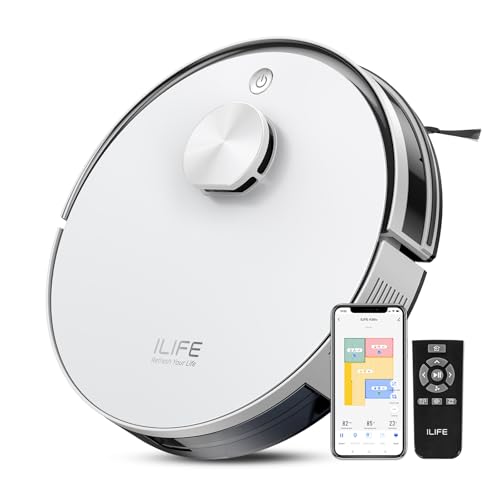
The ILIFE A30s is the entry pick because it lands at the cheapest price position in this set and still ships with lidar and a 1-year warranty.
Best for: a small starter home or a second floor Skip it if: you want the robot to empty itself
Budget robot vacuums usually strip navigation to save money. The A30s does not. ILIFE says the A30s uses LDS lidar with SLAM mapping, the same broad approach the pricier picks use, plus a dual anti-tangle brush that the listing recommends for pet households. The Spot mode suction figure is 10,000Pa, which is the highest number quoted in this set — but read it carefully, because it is a spot mode figure and not a continuous carpet claim. It is the lightest robot here at 5.95 lb, and the ILIFE Clean app carries no-go zones, virtual walls and room selection over 2.4GHz Wi-Fi. Alexa and Google Assistant both work. The trade-off is no self-empty dock, which is the wrydao's whole story, so a large family that runs the robot daily will end up emptying the bin every day. A 1-year warranty is printed, which matches the Roomba.
Pros:
- Cheapest of the six here
- 1-year warranty printed
- LDS lidar with SLAM mapping
- Lightest pick at 5.95 lb
- Alexa and Google Assistant support
Cons:
- No self-empty dock in the box
- 10,000Pa is a spot-mode figure, not continuous
- No mop function
- Onboard bin only
Why lidar matters more in a busy house
Lidar is a spinning laser rangefinder mounted on top of the robot. It sweeps the room in a full circle, measures distances to walls and furniture, and hands that data to the mapping algorithm. In a small apartment with three rooms, the difference between lidar and a cheaper sensor is minor. In a large family home with six or seven rooms, two levels and a permanent obstacle course of school bags and toys, the difference is everything.
Three concrete gains lidar delivers in a busy house:
- Room-by-room scheduling. The app carries a saved map so you can send the robot to the kitchen only, after dinner, without cleaning the whole floor.
- Multiple floor plans. Two picks here store more than one map, which matters if you carry the robot upstairs.
- No-go zones that stick. A no-go around a pet bowl or a floor vent survives between cleans because the robot recognises the mapped location.
The trade-off is that a lidar tower adds height to the robot. Every pick in this set sits between 3.74 in and 8.43 in tall, and the Shark's 8.43 in dimension is the base rather than the robot itself, but it still means checking your lowest sofa clearance before ordering.
How long can it actually run untouched?
The real question in a family of five or six is not suction, it is how many days can pass before an adult has to intervene. That is the specification a large-family buyer should compare first, and it splits this set into two groups.
Three picks publish a self-empty dock claim. The wrydao and the Tikom both quote a 3L bag and a 90-day hands-free window. The Shark AV2501AE lists a 60-day bagless base. Three picks — the roborock Q7 L5, the Roomba 105 and the ILIFE A30s — have no self-empty dock in the box, which means the onboard bin has to be emptied by hand after most cleans.
The 90-day and 60-day claims are manufacturer figures, and they assume an average debris volume. A large family with two dogs and a cat will fill the bag faster than a couple with no pets. The point is comparative: even at half the claimed life, the wrydao and the Tikom deliver 45 days between empties, while the onboard-bin picks deliver one clean. That gap is the reason the wrydao takes the top spot in a roundup framed around a big household. If daily maintenance is not a problem in your house, the roborock Q7 L5 gives you more raw suction for less money.
What size home does each pick suit?
Robots are usually described by suction, but for a large family the more useful frame is home size. Here is a rough matching, based on published run modes, dock capacity and app features:
- Small starter home, one storey, under 800 sq ft: the ILIFE A30s. One onboard bin, no upstairs to carry it to, and the price position is the entry tier.
- Mid-sized home, one to two storeys, pet in the household: the roborock Q7 L5. Multi-map support handles two levels, and the anti-tangle brushes handle the pet hair.
- Large single-storey home with mixed floors: the Tikom L8000 Plus. Three water levels and three suction levels cover tile, hardwood and low-pile rug in one run.
- Large multi-room home with allergy-prone family: the Shark AV2501AE. HEPA filtration is the specification that decides it.
- Large busy household, minimum daily attention: the wrydao S6 Pro. The 90-day hands-free claim plus auto carpet boost is the shortest route to leaving it alone.
- First-time buyer, wants a printed warranty: the Roomba 105. 1-year manufacturer warranty on a 2025 model.
This is a matching exercise, not a physics test. Every one of these robots will clean any of these homes eventually. The question is how much of your attention it consumes on the way.
Does the modifier hold up for large families?
Honest answer: partially. The listings in this set don't call themselves "large family" products, and Amazon's search treated the modifier loosely. None of the manufacturers publish a square footage figure or a household size figure. So how should you judge it?
Three specifications map to family size, and all three are present in the input:
- Dock capacity in days. The wrydao, the Tikom and the Shark all publish one.
- Suction level count. More levels means better handling of mixed floors, which every big home has.
- Multi-map support. One of the picks stores multiple floor maps, which is what a two-storey home needs.
If your household has more than four people, treat those three as the shortlist filter. Anything without a self-empty dock is going to consume daily attention. Anything without multi-map support forces you to re-learn the home every time you move it. Anything with only one suction level will fight a bathroom tile and a bedroom rug with the same tool. The best lidar robot vacuum for large families is the one that scores well on all three, and the ranking above puts the wrydao at the top because it does.
What the listings do not tell you
Manufacturer listings are marketing documents. Here is what is missing from every one of them, and how to work around it:
- Real square-foot coverage per charge. Not one listing here publishes it. Battery specs are absent across the set. Assume a lidar robot covers roughly one floor of a family home per charge, and expect a dock-and-resume cycle for anything larger.
- Noise level in dB. None of the six publishes it. If a baby naps mid-afternoon, schedule the robot around it, not through it.
- Filter replacement schedule. Only the Shark publishes a HEPA claim. The other listings mention filters but not intervals. Budget for a replacement filter twice a year and you will be close.
- Rug pile height limits. No pick states a maximum. High-pile shag will trip a lidar robot regardless of price.
- Cliff sensor behaviour. All six list lidar mapping; none details how the sensor behaves at a stair edge with a runner. Test it once, watched, before you trust it above a staircase.
The best lidar robot vacuum for large families is not the one with the best marketing. It is the one whose published specifications match the way your house actually runs.
The verdict
The best lidar robot vacuum for large families is the wrydao Robot Vacuum and Mop Combo, because it publishes the longest hands-free window in this set — a 3L bag with a 90-day claim — and pairs it with 6000Pa suction that steps up automatically on carpet. That combination is the shortest route to leaving the robot alone in a busy house.
Two conditions flip the ranking. If someone in the family is allergy-prone, the Shark AV2501AE takes over: it is the only pick here with a HEPA rating printed on the listing, and the 60-day bagless base is close behind the wrydao on run time. The threshold is a printed HEPA claim. Without it, filtration is a marketing word rather than a number. If daily bin-emptying is not a problem, the roborock Q7 L5 wins on raw suction with an 8000Pa figure and on dual anti-tangle brushes that keep long hair off the roller. The threshold is your tolerance for one small chore after every clean. If it bothers you, go back to the wrydao. If it does not, save the money and take the roborock.
FAQ
What is the best lidar robot vacuum for large families?
The best lidar robot vacuum for large families in this set is the wrydao Robot Vacuum and Mop Combo. Its 3L dust bag stretches maintenance to a claimed 90 days, its 6000Pa suction adds an auto carpet boost, and its app carries no-go zones for nursery doors and pet bowls. In a busy household, the run time between empties is the specification that decides it, and the wrydao publishes the longest one.
Is a lidar robot vacuum worth it over a cheaper model?
A lidar robot vacuum is worth it once your home has more than three rooms and more than one type of floor. Lidar builds a saved map that unlocks room-by-room scheduling, multi-floor plans and no-go zones that stick between cleans. In a small studio, a cheaper camera-based model does the same job. In a family home with a kitchen, playroom and bedrooms on separate schedules, lidar earns its price.
Do any of these robots have a HEPA filter?
Among these six robots, only the Shark AV2501AE publishes a true HEPA rating on its listing, quoted at 99.97% of particles down to 0.3 microns. The other five list filters but do not print a HEPA-grade rating. If a family member has asthma or a pollen allergy, that printed specification is the tiebreaker, and it is why the Shark takes the premium slot in this roundup.
wrydao S6 Pro or Shark AV2501AE for a house with pets?
wrydao S6 Pro or Shark AV2501AE both handle pet hair, but they solve different problems. The wrydao pairs 6000Pa with an auto carpet boost and a 90-day self-empty bag, so daily hair volume is dealt with in one place. The Shark pairs HEPA filtration with a self-cleaning brushroll and a 60-day bagless base, better for dander in the air. Pick the wrydao for the fur; pick the Shark for the allergens.
What is the most common mistake buying a lidar robot vacuum?
The most common mistake is comparing Pa figures without checking whether they are continuous or spot-mode numbers. The ILIFE A30s lists 10,000Pa, but that is a spot-mode figure. The roborock Q7 L5 lists 8000Pa continuously. The two numbers are not comparable. Check which mode the figure applies to, then check whether the robot has a self-empty dock, because run time between empties matters more than peak suction in a busy home.
Six robot vacuums, one decision, and the answer for most large families is the wrydao S6 Pro. Its published run time is the longest in this set, its suction adapts to the floor without an adult stepping in, and its price position sits below the Shark. Start there, and if a printed HEPA claim or a 1-year warranty outranks run time in your house, move up to the Shark or across to the Roomba. Whichever you choose, map the home once, set the no-go zones on day one, and let the robot learn the rooms before you judge it.