Best Self-Emptying Vacuum for Allergy Sufferers: Dreame Wins

Six self-emptying vacuums lined up by filtration claim, dock design and dust-bag capacity. The Dreame Z10 Station T leads, with a lightweight runner-up for smaller floors.

By Gabriela ChanUpdated 15 min read
On this page
- Best self emptying vacuum cleaner for allergy sufferers at a glance
- How I screened this shortlist
- 1. DREAME Z10 Station T — Best overall
- 2. Redroad Robot Vacuum R11G — Best premium
- 3. Klarpul Cordless Vacuum Cleaner — Most versatile
- 4. AlloyMove A05 Cordless Vacuum — Best minimal setup
- 5. VACDOCK Corejet 5 Cordless — Best upgrade
- 6. Jpbaisqic Replacement Dust Bags for Verefa L11 — Best budget pick
- The misconception about self-emptying and allergies
- What sealed dust bags actually do for dust exposure
- How much runtime do you really need?
- Which pick fits which floor plan?
- What the listings still do not tell you
- The verdict
- FAQ
The best self emptying vacuum cleaner for allergy sufferers is the Dreame Z10 Station T, a 13.2 lb stick vacuum whose 2.5L auto-empty base seals debris into a bag the listing says needs changing only every 90 days. If your allergy trigger is fine dust across a larger single-storey floor plan, the Redroad R11G robot vacuum takes over the job for you, and its 4L bag stretches the same idea out to a claimed 120 days.
Here is the misconception. Most guides to a best self emptying vacuum cleaner for allergy sufferers rank models by suction: 20,000 Pa, 50Kpa, 150AW. Suction pulls dust off the floor. It does not decide what happens to that dust next, which is the part your sinuses care about. What decides this category is the sealed path from bin to bag, plus the filter rating between the bag and the room. Read the picks below with that in mind.
Best self emptying vacuum cleaner for allergy sufferers at a glance
| Pick | Dock capacity | Filtration claim | Price |
|---|---|---|---|
Best overall DREAME Z10 Station T |
2.5L sealed bag 90-day claim |
5-layer sealed 99.9% claim |
Check Price |
Best premium Redroad Robot Vacuum R11G |
4L sealed bag 120-day claim |
Not published | Check Price |
Most versatile Klarpul Cordless Vacuum |
No dock; onboard bin | Not published | Check Price |
Best minimal setup AlloyMove A05 Cordless |
No dock; 1.5L bin | 7-layer, 99.99% claim | Check Price |
Best upgrade VACDOCK Self-Emptying Cordless |
Sealed bag in dock HEPA on stick |
HEPA filter claim | Check Price |
Best budget pick Jpbaisqic Bags for Verefa L11 |
9 replacement bags 4-layer |
99.7% claim | Check Price |




How I screened this shortlist
I started with the self emptying vacuum cleaner for allergy sufferers listings that publish specifications rather than just marketing copy. Then I cut anything without either a sealed dock or a documented filter layer count. Amazon's search does not treat "for allergy sufferers" as a strict filter, so I applied one myself.
Three things drove the ranking:
- A sealed emptying path. The vacuum must transfer dust into an enclosed bag, not a snap-open cup you shake over the bin.
- A published filtration claim, with a layer count. A number like 99.9% across five layers is checkable; "purifies the air" is not.
- Coverage matched to the dock. A 2.5L bag serves a stick used a few times a week. A 4L bag serves a robot running every day.
What got cut: bagless bin-only cordless models with no sealed transfer, and listings that quoted a Pa figure without any filtration detail at all. Six picks survived, and one of them, the ninth pick down, is a bag refill rather than a vacuum. It is here because dust bags are the consumable that make this category work at all.
1. DREAME Z10 Station T — Best overall
The Z10 Station T is the pick to beat because its sealed auto-empty dock and 5-layer filter target the two moments allergy sufferers care about most: bin emptying and exhaust.
Best for: an allergy-sensitive home with mixed carpet and hard floors. Skip it if: you need something under five pounds to carry upstairs.
At 13.2 lb this is the heaviest stick in the set. That weight buys you a 2.5L auto-empty base that Dreame says transfers debris into a sealed bag you swap once every 90 days, plus a filter the brand describes as a 5-layer sealed system capturing 99.9% of fine dust and allergens. Runtime is quoted at up to 65 minutes with 150AW of suction from a 7-cell 2,900mAh battery, which is enough for a run through a two-bedroom home before recharge. Dreame ships a multi-surface brush for carpet and a soft roller for hardwood and tile, and there is a blue LED head to reveal fine dust under furniture.
The trade-off is size. The dock's 48.3 x 10.1 x 14.5 in footprint needs a permanent home near a socket, and the vacuum itself is heavier than any of the cordless sticks below.
Pros:
- Sealed 2.5L bag with 90-day change interval claim
- Attributed 99.9% capture across five layers
- 150AW suction, 65-minute runtime claim
- Two brushes for carpet and hard floors
- Blue LED headlight for dust visibility
Cons:
- Heaviest pick here at 13.2 lb
- Dock needs floor space and a socket
- No stated warranty on the listing
2. Redroad Robot Vacuum R11G — Best premium
If you would rather never push a vacuum, the R11G runs on its own, docks itself and only asks for a new bag every 120 days.

Best for: hands-off cleaning across a larger single-storey home. Skip it if: you have deep-pile rugs or lots of stairs.
This is the only robot in the shortlist and the most expensive pick here. Redroad quotes 20,000 Pa of suction and 3,200 mAh of battery, and pairs the robot with a 4L dock bag the listing says lasts up to 120 days between changes, which is the longest hands-free interval in the set. Navigation is LiDAR-based with app control over 2.4G and 5G Wi-Fi, and the unit combines vacuuming, sweeping and mopping in one chassis. Unusual for a robot at this price, it lists a 2-year warranty.
Two limitations matter for allergy shoppers. Redroad does not publish a filtration percentage or a layer count, which is the exact number I want to see on this shortlist. And a robot only cleans what it can drive over, so stairs, sofa cushions and shelves stay your job.
Pros:
- 4L sealed bag with 120-day change claim
- 20,000 Pa suction figure
- LiDAR navigation and app control
- 2-year warranty stated
- Vacuum, sweep and mop in one unit
Cons:
- No published filtration percentage
- Cannot clean stairs or upholstery
- The most expensive pick here
3. Klarpul Cordless Vacuum Cleaner — Most versatile
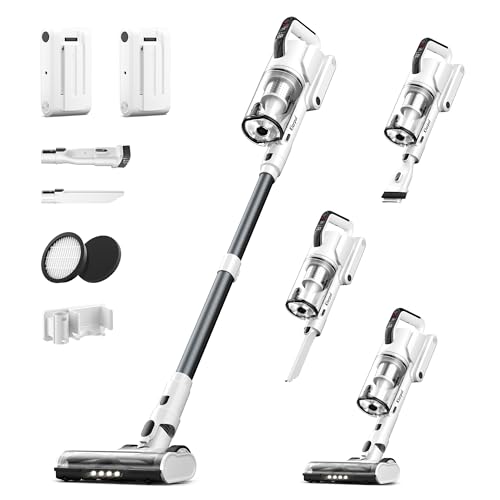
Klarpul trades a dock for two swappable batteries and 140 minutes of runtime, which is the longest cordless session in this set.
Best for: long cleaning sessions in a bigger apartment. Skip it if: you want an automatic dock that empties itself.
At 3.75 lb, this is the lightest full-size stick here, and Klarpul quotes 50Kpa of suction from a 600W brushless motor. The headline figure is runtime: two removable batteries deliver up to 140 minutes in ECO mode, with a 2.5-hour recharge on the included charger. The vacuum is self-standing, and a full accessory set ships in the box so there is nothing extra to add for pet hair, upholstery or crevices.
Here is where honesty matters. Klarpul does not publish a HEPA layer count or a filtration percentage in the listing, and there is no auto-empty base, so this is a self emptying vacuum cleaner for allergy sufferers only in the sense that you tip the bin yourself and rinse the filter. For a shopper whose priority is a sealed dock, this is not the pick. For a shopper whose priority is finishing a whole floor without swapping batteries, it is.
Pros:
- 140-minute runtime claim across two batteries
- Lightest full-size stick at 3.75 lb
- 50Kpa suction figure
- 2.5-hour charge time claim
- Full accessory set included
Cons:
- No auto-empty dock
- Filtration details not published
- Bin must be emptied by hand
4. AlloyMove A05 Cordless Vacuum — Best minimal setup
AlloyMove is the pick if you want the highest published filtration claim in the set without giving up a small footprint.

Best for: a small apartment where the vacuum has to stand in a corner. Skip it if: you dislike emptying a small bin by hand.
The A05 weighs 4 lb and ships with a wall-mount charger rather than a floor-standing dock, which is why I've called it the minimal setup pick. AlloyMove quotes 50kPa of suction across four power levels from a 550W brushless motor, with 80 minutes of runtime from seven 2,500mAh cells. The headline for allergy shoppers is the filter: the brand describes a seven-layer system with a multi-cone stage and a 99.99% capture claim, which is the highest published percentage in this shortlist. The floor brush uses a V-shaped anti-tangle roller and a green LED for dust visibility, and the bin holds 1.5L.
The trade-off is the same as Klarpul's. There is no sealed dock, so emptying that 1.5L bin remains a hand-and-lid job. Wear a mask over the trash can if that is your trigger point.
Pros:
- 99.99% capture claim across seven layers
- 50kPa suction with four power levels
- Light at 4 lb, wall-mount charger
- 80-minute runtime figure
- Anti-tangle roller for hair
Cons:
- No auto-empty base
- 1.5L bin emptied by hand
- No stated warranty on the listing
5. VACDOCK Corejet 5 Cordless — Best upgrade
VACDOCK is the entry-price way into the sealed-dock category, and the only stick here besides Dreame that empties itself.

Best for: a shopper who wants a HEPA filter and a self-emptying dock in one entry-price package. Skip it if: you need a lightweight stick.
The Corejet 5 pairs a cordless stick with an all-in-one charging dock that VACDOCK says empties debris into a sealed bag while charging, and clears dust from the HEPA filter during the transfer to help maintain suction. That combination, dock plus HEPA on the wand, is what this category is supposed to look like, and at the second-cheapest position in the set it is the accessible route in. The vacuum weighs 10.2 lb, has a removable battery, and uses a green LED head to catch fine dust along edges.
Two honest downsides. The listing does not quote a filter layer count or a capture percentage, which the Dreame and AlloyMove listings both do. And 10.2 lb is heavier than the Klarpul and AlloyMove sticks, so if you carry a vacuum upstairs, this one feels it.
Pros:
- Sealed-bag dock at an entry price position
- HEPA filter cited in the listing
- Removable battery
- Green LED for edge dust
- Second-cheapest pick here
Cons:
- No layer count or percentage published
- Heavier than the other cordless sticks
- No stated warranty on the listing
6. Jpbaisqic Replacement Dust Bags for Verefa L11 — Best budget pick
A 9-pack of sealed replacement bags for the Verefa L11 Pro dock, and the cheapest of the six.

Best for: owners of a Verefa L11 Pro who need spare sealed bags. Skip it if: you own any other vacuum.
This is here because the consumable is the point. A self-emptying vacuum only helps allergy sufferers if you keep the sealed bag stocked, and Jpbaisqic sells nine at once at the cheapest position in the shortlist. The bags are described as a 4-layer construction: two non-woven layers, one meltblown layer and one activated carbon layer, with a 99.7% dust-blocking claim and a tool-free tab pull for replacement. Compatibility is narrow, so read the listing carefully: these are stated as compatible only with the Verefa L11 Pro station.
The trade-off against the picks above is obvious. This is not a vacuum. It only helps you if you already own the matching machine, and there are two sellers rather than one. Buy on fit, not on price.
Pros:
- Nine sealed bags in one order
- 4-layer construction with carbon layer
- 99.7% dust-blocking claim
- Tool-free tab installation
- Cheapest listing in the set
Cons:
- Fits only the Verefa L11 Pro station
- Not a vacuum on its own
- Two sellers, one may sell out
The misconception about self-emptying and allergies
The pitch on every self-empty product is the same: you never touch the dust. That is only partly true, and pretending otherwise is what makes people buy the wrong machine.
A self-emptying dock reduces the number of times per year you open a bin and shake it into the trash. From roughly weekly, on a normal cordless, to roughly quarterly, if you trust the Dreame's 90-day claim or the Redroad's 120-day claim. That is the win, and it is a real one for someone whose reaction is triggered by the emptying step.
What the dock does not do is capture the fine particles the machine agitated into the air while you were vacuuming. That job belongs to the filter on the stick or the robot, not to the dock. So the checklist for a best self emptying vacuum cleaner for allergy sufferers has two lines, not one: a sealed transfer path, and a documented filter behind it. Two of the picks here publish both. Two publish one and leave you to guess the other. That is the difference between the top of the shortlist and the middle.
What sealed dust bags actually do for dust exposure
Sealed bags matter for two moments: the moment the vacuum transfers debris into the base, and the moment you lift the full bag out to bin it.
- During transfer, air is being blown through captured dust at speed. A snap-on lid can leak. A bag with a gasketed collar and a self-sealing tab, like the four-layer Jpbaisqic pattern, is designed to hold the flow inside the fabric.
- On removal, the tab-pull design means you do not tip a canister. You lift the bag out with the opening already closed, drop it in the trash, and the fibres you disturbed most are the ones already sealed inside.
Layer count is a useful proxy but not a guarantee. Four layers with an activated carbon stage, as on the budget pack, target odour as well as particles. Five layers, as claimed by the Dreame system, target sub-micron dust and allergens. Neither is a substitute for a HEPA filter on the vacuum itself, and neither is a medical certification. Read layer counts as the manufacturer's engineering shorthand, not as a test result.
How much runtime do you really need?
This is where the picks split sharply. Runtime is the specification most shoppers skim, and it is the one that decides whether you finish a room in one pass.
Match your floor plan to the numbers:
- Under 700 sq ft, mostly hard floors. The AlloyMove's 80-minute figure is more than enough, and its 4 lb weight suits a small apartment.
- 700 to 1,500 sq ft, mixed floors. The Dreame's 65-minute figure covers this comfortably, and the two brushes handle the transition between rug and hardwood without a swap.
- Bigger footprint, or you like to clean everything in one go. The Klarpul's 140-minute claim across two batteries is the outlier here, though you pay for that runtime by giving up the auto-empty dock.
- You would rather not push at all. The Redroad robot runs on a schedule, so runtime translates to coverage per cycle rather than session length.
Runtime figures on cordless vacuums are almost always quoted in the lowest power mode. Assume the number drops by half on turbo, and plan the pick around the mode you will actually use most days.
Which pick fits which floor plan?
- Studio or one-bed apartment, mostly hardwood: the AlloyMove A05. Light, wall-mounted, quick to grab, and the strongest published filtration claim.
- Two-bed with a mix of carpet and hard floors: the Dreame Z10 Station T. Two brushes, a sealed dock, and enough runtime to finish in one session.
- Single-storey home you would rather not clean yourself: the Redroad R11G. Long dock interval, LiDAR routing, warranty on the box.
- Bigger apartment, no room for a floor dock: the Klarpul. You give up the sealed transfer, but 140 minutes of runtime and 3.75 lb of stick to carry is a fair trade if runtime is the constraint.
- Entry-price shopper who still wants the dock: the VACDOCK Corejet 5. HEPA on the stick, sealed bag in the dock, second-cheapest of the six.
- Already own a Verefa L11 Pro: the Jpbaisqic 9-pack. Keep the bag stocked and the whole system keeps working.
What the listings still do not tell you
Every listing in this set omits at least one thing an allergy shopper wants to know, and honesty about that gap is more useful than pretending it is not there.
None of the six publishes a third-party HEPA test result, only the manufacturer's own claim. None publishes noise figures in decibels, which matters for anyone sensitive to the burst of a dock cycle. Only the Redroad states a warranty. And "self-emptying" means different things across the picks: on the Dreame and VACDOCK it is a floor-standing base; on the Redroad it is the robot's own dock; on the Klarpul and AlloyMove there is no dock at all, and you are back to lifting a lid.
Two workarounds close the gap. Buy replacement bags in a multi-pack early, so you never run down to the last one and shake a full bin out of desperation. And run the vacuum before you leave the house, not while you are sitting on the sofa in the room being cleaned. Both are boring and both work.
The verdict
At the entry tier, the VACDOCK Corejet 5 is the cheapest way into the sealed-dock category, and its HEPA claim on the wand plus a self-emptying bag in the base are what a best self emptying vacuum cleaner for allergy sufferers is supposed to offer. Accept the 10.2 lb weight and the missing layer count, and it is a reasonable first move.
In the middle, the Dreame Z10 Station T is the overall winner. The 2.5L sealed bag with a 90-day change claim, the 5-layer filter with a 99.9% capture claim, the 65-minute runtime and the two floor brushes together answer more of the allergy checklist than anything else here. It is heavier than the cordless sticks, and the dock takes floor space, but that is the price of the feature you came for.
At the premium tier, the Redroad R11G is the pick if your priority is not touching the vacuum at all. The 4L bag stretches emptying out to a claimed 120 days, LiDAR handles the routing, and the 2-year warranty is the only stated warranty in the whole shortlist. It gives up filtration transparency to get there, so read the listing carefully before you commit.
FAQ
Is a self emptying vacuum cleaner for allergy sufferers actually worth it?
A self emptying vacuum cleaner for allergy sufferers is worth it if the emptying step is your specific trigger. The dock cuts hand-emptying from roughly weekly on a normal cordless to roughly quarterly on the Dreame's 90-day claim or the Redroad's 120-day claim. If your trigger is fine dust in the air during cleaning, the filter on the vacuum matters more than the dock.
What is the difference between the Dreame Z10 Station T and the Redroad R11G?
The difference is who does the work. The Dreame is a 13.2 lb stick you push, with a 2.5L sealed bag and a 5-layer filter claim. The Redroad is a robot you schedule, with a 4L sealed bag and a 120-day change claim. Choose the Dreame for control and mixed floors, the Redroad for hands-off coverage of a single storey.
Does a HEPA filter matter if the vacuum already empties itself?
Yes. A HEPA filter matters because self-emptying and filtration solve different problems. The dock stops dust escaping during transfer to the bag. The filter on the vacuum stops fine particles escaping through the exhaust while you are cleaning. The Dreame and VACDOCK listings both cite HEPA-grade filtration. Klarpul and Redroad do not publish a layer count or a percentage on the listing.
How often do I really need to change the sealed bag?
How often you change the sealed bag depends on floor area and pet hair. Dreame quotes up to 90 days on a 2.5L bag; Redroad quotes up to 120 days on a 4L bag; the Jpbaisqic pack advertises 45 days per bag on the compatible Verefa station. Larger homes and multi-pet households will hit the shorter end of every range. Buy spares in a multi-pack early.
Can a robot vacuum replace a stick vacuum for an allergy sufferer?
A robot vacuum can replace a stick vacuum for daily floor upkeep, but not for the whole job. The Redroad R11G handles routine passes across floors it can drive over, which reduces the frequency of manual vacuuming. It cannot clean stairs, sofa cushions, mattresses or shelves, so most allergy-sensitive households pair a robot with a lightweight stick like the AlloyMove for the surfaces the robot cannot reach.
Start with the Dreame Z10 Station T if you want one machine to solve the allergy checklist in a single purchase: a sealed dock, a published filter claim and enough runtime for a real floor plan. Move to the Redroad if you would rather schedule cleaning than do it, and to the VACDOCK if the entry price is the deciding constraint. What ties the shortlist together is the sealed bag, not the suction number, and it is the reason a well-chosen self emptying vacuum cleaner for allergy sufferers pays back on the third month when you realise you have not shaken a bin over the trash since you bought it.